Intentions, motives, and what makes for a valid sacrament

The question of invalid baptisms has been in the news recently. In my commentary on the question in La Civiltà Cattolica, I pointed out that the Vatican’s most recent document on the question, Gestis verbisque, gives renewed attention to the minister’s intention. For a sacrament to be valid, a minister must intend to do what the Church does when celebrating that sacrament. And that means that if he changes what the Church prescribes in her official liturgical texts–by inserting his own words or deleting something required to be there–then he manifests an intention to do something else. It’s just as straightforward as it sounds. The proof is not in the pudding, but in the action.

Baptismal font, St. Peter’s Basilica

Last week, however, another question was sent to the Vatican about what sort of intention might invalidate a sacrament, this time an ordination. The question proposed the distasteful case of a bishop who ordained a man with whom he had engaged in an illicit sexual relationship. Could he possibly have the right intention? Wouldn’t such a sinful situation invalidate the ordination?

The article in which this question was raised described it as “potentially explosive.” Fortunately, this grenade was defused by St. Augustine in the fifth century. The great theologian was responding to controversy about the validity of baptisms, whether the sinfulness of a minster invalidated the sacrament. He responded no. Augustine’s principle has remained a bedrock of sacramental theology ever since. It is really Christ who baptizes, Augustine said, and he can do so even through profoundly imperfect human instruments. The same goes for ordinations. Augustine sagely realized that if perfection were required of ministers in order for sacraments to be valid, then we simply wouldn’t have sacraments.

So how does Augustine’s principle fit with the requirement that one has to have the right intention to celebrate a sacrament validly? Here we have to make what might at first seem like a rather technical distinction but is, once you’ve thought the question through, also rather straightforward. The distinction is between intention and motive.

Continue reading “Intentions, motives, and what makes for a valid sacrament”

Andrea Grillo and Rachel Lu on Baptism of Desire and Christian Salvation

Sant’Anselmo, Rome

Earlier this month, after delivering ten copies of Baptism of Desire and Christian Salvation to Sant’Anselmo at Easter time, I walked up the Aventine Hill to pick up my diploma–the last formality involved in earning my doctorate. The last act, I suppose, of my formal education! It’s a walk I made many times before while a student. I haven’t been back to Sant’Anselmo for a while now, but am grateful for the studies in sacramental theology I did there.

When I received my copies of Baptism of Desire and Christian Salvation, I had one more reason to be grateful — the insightful words of endorsement on the back cover from my dissertation director Prof. Andrea Grillo, who read many draft versions of the tome and managed to remain in good humor throughout! Here’s his review:

Lusvardi offers a historical reconstruction of the ‘baptism of desire’ that traverses the entire arc of the Christian tradition, starting from the origins. A straightforward work, expressed in a language endowed with finesse, irony and acumen. Baptism of Desire and Christian Salvation is singularly effective in pointing out the fact that in the modern reception, a series of priorities is imposed on the issue that empty its meaning.

Andrea Grillo, Pontifical Atheneum of Saint Anselm, Rome

Also last week, I was delighted to see Rachel Lu’s review of the book at Word On Fire. Rachel’s review had a particular significance for me since, as she points out, I was there when she was baptized as an adult 19 years ago.

Filippo and Filippino Lippi at Rome’s Capitoline Museum

Filippo Lippi, Madonna of Humility, 1420

Though I still have a few weeks of grading exams to go, summer is definitely here in Rome. To celebrate the end of classes, I took a morning off last week to visit a special exhibit at Rome’s Capitoline Museum. The Capitoline is one of several museums in the Eternal City that would be the top attraction anywhere else but gets overshadowed by the Vatican Museums and the Borghese Gallery. It contains a number of impressive ancient Roman sculptures and a couple of Caravaggios — antiquity and baroque being the two periods Rome is known best for. When it comes to Renaissance art, Rome takes second place to Florence (though, given the work of Michelangelo and Raphael in the Vatican, the competition is still stiff).

In any case, the Capitoline is hosting an exhibit this summer dedicated to the work of Filippo Lippi (1406-1469) and his son Filippino (1457-1504). I mentioned Filippo before for his wonderful frescoes in Spoleto’s cathedral depicting the life of the Virgin. Filippo grew up an orphan and very poor. He was raised in a Carmelite monastery in Florence and became a monk. His superiors noticed his talent and encouraged his artistic career. He proved, in fact, to be a better artist than a monk. While executing a commission in a monastery in Prato, he ran off with a 17-year old novice, Lucrezia Buti, who became the model for some of his most beautiful female figures. Filippino, you might have guessed, was the fruit of their union.

Continue reading “Filippo and Filippino Lippi at Rome’s Capitoline Museum”

A bloody Sunday: Corpus Christi homily

Homily for the Solemnity of Corpus Christi (B)

Today’s readings are bloody.  Some years the readings for Corpus Christi emphasize the bread that becomes the body of Christ, and they remind us that the Eucharist is our nourishment and also the source of our unity.  A single loaf of bread is formed from many individual grains of wheat.  

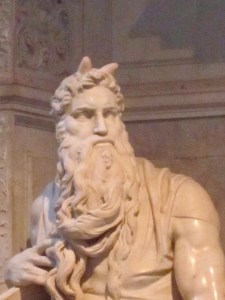
Moses, Michelangelo

But today’s readings are full of blood.  This is not a Sunday for the squeamish.  Blood sprinkled, blood shed, blood poured out, drinking blood.  If we are tempted to imagine that worship is something abstract or comfortable or safe, the blood-spattered images in today’s readings should give us second thoughts.  In the ancient world and in the time of Jesus, worship was a matter of flesh and blood, of life and death.  Entering the Temple of Jerusalem would have been a shock to the senses—crowds of visitors both from Judea and from the Jewish diaspora; animals—birds, sheep, goats, bulls—and all their animal noises and smells; the sounds of these animals being slaughtered; the smell of blood; and the songs of prayer, of the psalms rising to heaven, with the smoke of burning incense and roasting meat.  Worshipping God was not for the squeamish.

I think the fact that today’s readings speak rather vividly of the blood of goats, heifers, and bulls—bowls of blood—is perhaps a way of reminding us that Christianity—following Jesus—requires a certain courage.  In one way or another we all have to overcome our squeamishness, whatever form it might take.  The perfect act of worship, after all, the sacrifice which is the model for all other acts of worship, the death of Jesus on the cross, was not only bloody, but brutal.  There was nothing abstract or comfortable in the scrouging and beating, in the nails, the crown of thorns, or the agonizing hours on the cross.  And yet this was not, in the final analysis, merely an act of violence or a miscarriage of justice but an act of self-giving love.  The blood of the new covenant was shed for those Jesus calls to be his friends and disciples.

But why blood?  What is the meaning, for example, of what probably seems to us the very strange gesture of Moses who, to seal the covenant between God and his people, splashes blood upon the altar and then sprinkles it on the people.  When I read this passage one of my first very modern, very practical thoughts is, “How are the Israelites going to get all that blood out of their clothes?  What a mess!”  But we are told, in the letter to the Hebrews, that it is blood—the blood of Christ—that cleanses.

Continue reading “A bloody Sunday: Corpus Christi homily”