Granados endorsement

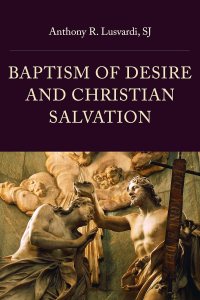
Just a friendly reminder that if you haven’t yet ordered your copy of Baptism of Desire and Christian Salvation, at a mere 20 cents/page, it remains a bargain. And each page is jam-packed with non-stop theological action.

You might think I’m biased, but you don’t have to take my word for it. When the book came out, I was thrilled to see that CUA Press had arranged a review and endorsement from Fr. José Granados. Attentive readers will recall that I mentioned Fr. Granados’s superb Introduction to Sacramental Theology here before. (It’s now available in Italian under the title Teologia dei sacramenti: Segni di Cristo nella carne.)

Here’s his verdict:

Offers a very accurate historical analysis of the doctrine of baptism of desire, starting with St. Ambrose and St. Augustine up to Vatican II. Lusvardi does not only give information about the different Fathers and theologians but delineates a clear leading thread that allows us to follow the development of the idea. The analyses are precise, the bibliography is abundant and well chosen, the documentation is excellent, the theological approach very sound.

José Granados, author of Introduction to Sacramental Theology: Signs of Christ in the Flesh

Some recent publications…

Lisbon, Portugal

I’m honored to have a couple of recent works appear in print in the past few weeks, the first an article in La Civiltà Cattolica, a publication founded by Italian Jesuits in 1850, which has since gone international. The article “Gestis Verbisque: The Words and Actions of the Sacraments” (the Italian is here) analyzes a recent Vatican document dealing with sacramental theology — specifically the question of invalid baptisms. The document Gestis verbisque was available only in Italian at the time I wrote the article, but has since come out in English (and other languages) here. It’s an important document because it reminds priests and deacons of the need to faithfully celebrate the sacraments according to the Church’s tradition and liturgical books. We probably all have had unfortunate experiences of goofy things happening in liturgy because Father thought that he could improve upon a centuries-old ritual with regrettable results. Gestis verbisque reminds us that “The Church is the ‘minister’ of the Sacraments, but she does not own them.” My own article fleshes out some of the background behind the document and points out where I think it adds something theologically (its treatment of the minister’s intention). It was interesting to see some of the strange cases in history that I found while researching Baptism of Desire and Christian Salvation come up again in modern settings. You’d think we’d learn!

The other publication is the first short story I’ve published in a while–too busy with academic work–in a magazine that will be familiar to readers of these pages, Dappled Things. Dappled Things is the only literary magazine I know of dedicated exclusively to Catholic literature. I’ve been honored to have a number of short stories and essays appear in their pages over the years, some of which can be found on their site. My most recent story, “Pious Tchotchkes,” is in their Easter 2024 issue, which is only available in print. Their print issues are always beautifully crafted.

The story is set in Portugal, and here are a couple of places alluded to — baroque exuberance in Coimbra and Cabo da Roca, the westernmost point in continental Europe.

Ascension

Transfiguration, pulpit (Pisan 1160), Cattedrale, Cagliari

“Today our Lord Jesus Christ ascended into heaven; let our hearts ascend with him. Listen to the words of the Apostle: ‘If you have risen with Christ, set your hearts on the things that are above, where Christ is, seated at the right hand of God; seek the things that are above, not the things that are on earth’ (Col. 3:1-2). For just as he remained with us even after his ascension, so we too are already in heaven with him, even though what is promised us has not yet been fulfilled in our bodies.”

St. Augustine, homily on the Lord’s Ascension, quoted in Robert Imbelli’s
Christ Brings All Newness (Word on Fire Academic, 2023), p. 144.

The bodily resurrection of Jesus

Galleria degli Arazzi (Gallery of Tapestries), Vatican Museum: The Resurrection, Raphael, 1519

As we near the end of the Easter season, I’ve been reading the latest book of Fr. Robert Imbelli, Christ Brings All Newness (Word On Fire Academic, 2023). It is a fine collection of essays on everything from Vatican II to Dante, all held together by the wonder and uniqueness of the Son of God’s entry into the world. The title comes from St. Irenaeus of Lyons: “Christ brought all newness in bringing himself.”

To give a taste of the book–and as we approach the Ascension–I thought I’d share some of Fr. Imbelli’s words on the Resurrection from the essay “Resurrection and Real Presence.” Insisting on the bodily resurrection of Jesus–and not some watered-down academic knock-off–Imbelli again demonstrates a truly sacramental sense of the body’s importance, which I mentioned in another post a few weeks ago.

“Resurrection faith stretches heart and mind to the breaking point, as they stagger under the unbearable lightness of being. Is it any wonder that we frequently retreat before the mystery, reducing it to more manageable perspectives? And so, certain scholars contend, ‘He is risen into the kerygma’–betraying thereby their inordinate appetite for ideas. No resurrection there, only a ghostly apparition. Or, some ecclesiastical functionaries insist, ‘He is risen into the institutional church”–displaying, by the very contention, a rather petrified imagination. That would merely exchange one tomb for another. Or, others of more liberationist bent cry, ‘He is risen as the people’–manifesting their often havoc-wreaking innocence. A provocative resuscitation, perhaps, but no true resurrection. But against all infringement of the mystery, the angel stands adamant: ‘He is risen; he is not here!'” (pp. 158-9)