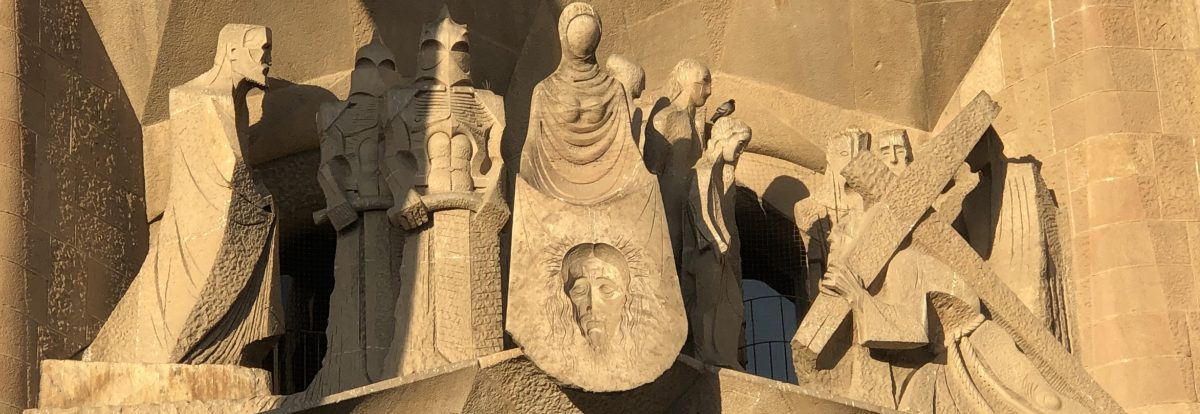
I recently read something in a book written by an American sociologist that struck me–and disturbed me. This sociologist is a very good scholar and has conducted studies in several different countries and written a number of topics. In one of these studies, as an aside, he mentioned that, in general, people care more about being normal than about being good. For the majority of people it is more important to feel normal than to be good.

This disturbing observation struck me because it seemed hard to deny. And the truth of this observation is evident on no other day more than on this one, Palm Sunday. The celebration begins with Jesus’ triumphal entry into Jerusalem. The people welcome him as a hero, as a king. They throw their cloaks before him and cheer him enthusiastically, “Hosanna!” And in the space of a week, the same crowd will shout with the same enthusiasm, “Crucify him!”
On no other day do we feel so acutely the fickleness of the crowd or the inconstancy of the human heart.
Probably some of those in the crowd shouting for Jesus’ death were so caught up in the passions of the moment that they forgot their acclamations of a few days earlier. In fact, perhaps those acclamations were not signs of true faith, but only a moment of fervor, a momentary feeling without real commitment.
Perhaps some felt pangs of conscience but were afraid to stand out from the crowd, to go against the flow of events, the sense of inevitability. This remains the weakness of Christians today; we are often afraid to contradict enlightened and acceptable opinion, what the media calls progress. “It wouldn’t be my choice,” we say, “but the people have spoken, so let him be crucified.” In the age of social media and of influencers, the power of the crowd has become even more aggressive. Today we don’t have to go out into the street be carried away by the passions of the crowd; instead, the flood of passions, channeled by carefully calculated algorithms, controls us by means of the small device we carry in our pockets.
Today, however, is not the Sunday of the Crowd. It is Palm Sunday of the Lord’s Passion. And despite all the manipulations of the Pharisees, despite the propaganda victories of the leaders of the people, despite the noise and violence of the majority, today is the Lord’s Day.
Jesus Christ reminds us of the things that the crowd cannot offer us: integrity, truth, salvation. Throughout the accounts of Jesus’ passion we can sense the frustration of the chief priests and of Pontius Pilate because this man is not like the others, because they cannot control him the way they control others, because he is not normal.
And here is the lesson that is repeated every year–repeated every year because we still need it. Salvation does not come from the crowd, from polls, from public opinion, from historical progress, from normalcy-it comes from Jesus Christ and Jesus Christ alone. For us the key word is: disciple. To the question “how to live?” this is our answer. Not by always trying to be normal, to please others, to keep up with fashions, or repeat the phrases of the moment, but by listening to Jesus, learning from Jesus, imitating Jesus, following Jesus, as disciples, because what he offers is above the ordinary. This is true freedom-what few in this world find-this is integrity, and, as we will see in a week, this is eternal life.
Probably our desire to be normal, even at the expense of being good, comes from the fear of being alone. We try to hide in the crowd because we do not want to be left out. This week we see Jesus abandoned, left outside of Jerusalem. But he is abandoned because in the moments when we feel alone and abandoned, he will already be there. Even the loneliness of the tomb will no longer be loneliness because Jesus will be there already for us. When we choose the truth, we are not alone, even if the whole world seems to be against us. We are with him. And this is the austere choice with which the liturgy of Palm Sunday confronts us: do we choose him?
To make this choice the noise of the crowd does not help us. Instead, we must listen for the constant voice of conscience–the voice that has called us here this morning to meet Jesus, to hear his story again, to find him in the sacrament–the voice of truth that spoke to the centurion as he stood before that pierced body on that terrible and holy Friday and moved him to say, against the opinion of the leaders, the people, and the imperial authorities, “Truly this man was the Son of God.”
(Original: Italian)
Readings: Mk 11:1-10, Is 50:4-7, Phil 2:6-11, Mk 14:1-15:7
Maracalagonis (Sardinia), Italy
March 24, 2024
And just a reminder, if you haven’t done so already, consider subscribing to this blog:

 Tony Lusvardi, S.J.