Baptism of Desire and Christian Salvation

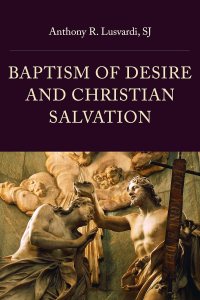
My book Baptism of Desire and Christian Salvation is now available to order, though its shipping date will be a little later. Its official publication date was originally last Friday but now seems to have been bumped to March. I’ve been working on the topic of baptism of desire since my STL studies at Sant’Anselmo–a good six years ago–so it has been a long time coming. I think the result says some important things for Catholic theology and the evangelizing mission of the Church. So let me assure you, it’s worth the wait!

I’ll have more on the topic to say, of course, and I’ll share the reactions of others to the book so you don’t have to take my word for it. For now I’ll just share the official description from Catholic University of America Press. The book is available directly from CUA’s website as well as other online booksellers such as Amazon. This spring CUA is offering a 20% discount on new books with the promo code CT10. Make sure that your library gets a copy, too!

Baptism of Desire and Christian Salvation. Belief in the necessity of baptism for salvation is rooted in the New Testament and was forcefully affirmed by the Church Fathers, yet today this belief is treated with unease if not ignored altogether. Over the course of centuries, Catholic theology has wrestled with a doctrine—baptism of desire—that both preserves this fundamental principle and allows for salvation in hard cases, such as catechumens dying unexpectedly. Baptism of Desire and Christian Salvation traces this doctrine’s varied history, from its genesis in a fourth century funeral oration given by Ambrose of Milan to its uneasy position in the Anonymous Christianity of Karl Rahner. 

More than a history, however, this book raises questions about the nature of religious ritual and the sacraments, the mission of the Church, and the essence of salvation. Arguing that theologians of the past two centuries have tended to downplay the role of the sacraments when discussing salvation, Lusvardi suggests that baptism should remain our theological starting point. Engaging with the theological tradition and at times challenging the conventional wisdom, Baptism of Desire and Christian Salvation shows how such a sacramental approach can offer credible—and sometimes surprising—responses to questions related to the salvation of non-Christians, the fate of unbaptized infants, and the relevance of the Church’s mission today.

Praying for confusion

Church of St. Ignatius, Rome

One of the more puzzling turns of phrase in the Spiritual Exercises comes early in the First Week when St. Ignatius directs the person making the Exercises to ask God for “shame and confusion” for one’s sins (48). Shame I get; we ought to feel ashamed for our sins. If we say someone has no sense of shame, it means his conscience isn’t working. But confusion?

Confusion seems to cut against the whole thrust of the Spiritual Exercises and, indeed, Ignatian discernment in general. Isn’t the whole point of doing the Exercises to see the world more clearly, to cut through the illusions thrown up by the Evil Spirit in order to make good decisions and then stick to those decisions with confidence? Confusion is what we feel when we’re lost.

Continue reading “Praying for confusion”

Be made clean: Homily for the Sixth Sunday of Ordinary Time

Homily for the Sixth Sunday of Ordinary Time (B)

Five years ago, if we had read this passage from Leviticus, we might have looked rather harshly at the Old Testament rules for the treatment of lepers.  Making a man shout “Unclean, unclean!” and dwell apart, outside the camp—quarantined—might have seemed unenlightened.  

Church of St. Ignatius (ceiling), Rome

Four years ago, about this time of year, all those purity laws in Leviticus started to look a lot more familiar.  We made each other dwell apart outside the camp, in quarantine, not because a scab or pustule or blotch had appeared, but because it might, you never know, you can never be too safe.  Suddenly those purity laws were not so unreasonable after all.

When we read the Gospel, we usually imagine that of course we would take the side of Jesus instead of the Pharisees.  But I wonder.  Look at Jesus in today’s Gospel passage.  No six feet of social distancing, no mask, no respect for the opinion of the experts, touching the infected without hand sanitizer before or after—would we really take the side of Jesus?

Continue reading “Be made clean: Homily for the Sixth Sunday of Ordinary Time”

From John Paul II’s “Letter to Artists”

Every genuine artistic intuition goes beyond what the senses perceive and, reaching beneath reality’s surface, strives to interpret its hidden mystery. The intuition itself springs from the depths of the human soul, where the desire to give meaning to one’s own life is joined by the fleeting vision of beauty and of the mysterious unity of things. All artists experience the unbridgeable gap which lies between the work of their hands, however successful it may be, and the dazzling perfection of the beauty glimpsed in the ardour of the creative moment: what they manage to express in their painting, their sculpting, their creating is no more than a glimmer of the splendour which flared for a moment before the eyes of their spirit.

Believers find nothing strange in this: they know that they have had a momentary glimpse of the abyss of light which has its original wellspring in God. Is it in any way surprising that this leaves the spirit overwhelmed as it were, so that it can only stammer in reply? True artists above all are ready to acknowledge their limits and to make their own the words of the Apostle Paul, according to whom “God does not dwell in shrines made by human hands” so that “we ought not to think that the Deity is like gold or silver or stone, a representation by human art and imagination” (Acts 17:24, 29). If the intimate reality of things is always “beyond” the powers of human perception, how much more so is God in the depths of his unfathomable mystery!  […]

Beauty is a key to the mystery and a call to transcendence. It is an invitation to savour life and to dream of the future. That is why the beauty of created things can never fully satisfy. It stirs that hidden nostalgia for God which a lover of beauty like Saint Augustine could express in incomparable terms: “Late have I loved you, beauty so old and so new: late have I loved you!”

From Pope St. John Paul II, Letter to Artists (1999)