
This week marks the end of the first semester at the Greg. One of the semester’s blessings has been the seminar I taught on the sacrament of marriage, which looked first at some classic theological texts on the subject and then attempted to grapple with the contemporary problems the Christian vision of marriage faces. No small task, and I learned much from the discussion. I’m grateful to my lively group of students.
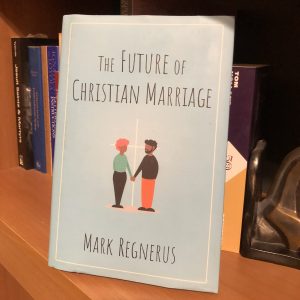
To guide our discussion I assigned sociologist Mark Regnerus’s engaging and insightful book The Future of Christian Marriage (Oxford 2020). The book makes use of social surveys, Regnerus’s own extensive research on the subject, and 200 interviews conducted with young Christians in seven different countries. My students–who hailed from a total of eight different countries–found the book quite helpful for understanding the situation they themselves face. Having real-world data also improved our theological discussion, which, in today’s climate, can sometimes get bogged down in sloganeering.
At the root of Regnerus’s argument is the contention that attitudes toward marriage have changed from seeing it as a “foundation” to seeing it as a “capstone.” In other words, instead of a unit based on mutual exchange that helps a couple to weather life’s uncertainties, young people have increasingly come to see marriage as a capstone one acquires only after attaining personal, financial, and career success. This means that marriage is delayed, comes with more difficult-to-realize expectations of one’s spouse, and, for many, ultimately becomes unattainable. This is all part of the “atomization” of society as individuals become our primary social grouping at the expense of families.
Marriage is undoubtedly good for society, and good for individuals; it’s associated with all sorts of beneficial social outcomes from financial stability to better health. When individuals have to achieve these outcomes before entering into marriage, they cannot benefit from the goods that the institution provides. The downward slump in marriage we see throughout the West–and the globe, as we lurch toward commercialistic “monoculture”–ought to be a cause of concern to everyone, Christian or otherwise.
Regnerus’s book is full of references to studies on related themes (such as the negative effect of premarital sexual relations and cohabitation on marital stability and the effect of divorce on children). He offers both some suggestions for “revitalizing Christian marriage,” as well as predictions for the future. In the short term, we probably have some stormy seas to navigate, as many of the destabilizing forces in society that have undermined marriage over the past decades play themselves out.
On the other hand, as one studies the teachings on marriage of recent popes from Leo XIII to John Paul II, one is struck not just by how forceful they were in proclaiming the Christian vision of marriage, but by how accurate their predictions were with regard to the consequences of disregarding those teachings. These teachings, it seems to me, remain a source of direction, hope, and grace for a world very much lacking in all those things. A glance at history is also encouraging. Christianity’s demanding marital ethic was undoubtedly one of the sources of the new faith’s strength both in the Roman world and in the aftermath of that world’s collapse; and it can be so again, even if Christians, in many places, are a minority.
More can and should be said, of course, but Mark Regnerus’s The Future of Christian Marriage is a good place to begin many discussions the Church badly needs to have.

 Tony Lusvardi, S.J.
3 thoughts on “The Future of Christian Marriage”