Homily for the 21st Sunday in Ordinary Time (A)

How do you feel about authority? I wish I had a little more? I wish those with it would loosen up a bit? I wish they’d clamp down? When you hear the word authority do you feel defensive or safe?
Even if you don’t like the word, even if you like to think of yourself as a freethinker, you still rely on authority. Almost everything we believe, we’ve come to believe on the authority of others. Many of today’s political and social controversies come down to authority—can we trust the media? The experts? Universities? Business? Government? The Church?
Yes, authority is important for the Church because the Church is a human institution. Instituted by God, guided by God, but made up of men and women like you and me. And each of us depends upon authority. Any complex human undertaking—even rowing a boat in unison—requires some degree of authority if the boat is to go anywhere. Learning requires trusting authority as well. If you saw the eclipse last Monday, you probably relied on the authority of the news media, who relied on the calculations of scientists, relying on the observations of centuries of scientists and mathematicians before them. Or maybe you really are a freethinker, and figured it all out yourself with binoculars and a calculator.
Today’s readings put the spotlight on religious authority. In the first reading, one official in the palace of the king of Israel, Shebna, is condemned and replaced by another, Eliakim. Just before the part we read this morning, Isaiah explains that Shebna is being fired for looking after his own personal interests instead of the people’s. Specifically, he seems to have used public funds to construct an elaborate tomb for himself. Eliakim, on the other hand, cares for the people of Jerusalem like a father.
We can observe a few of things from this story of petty corruption. First, authority is different than power. Power can be seized, but authority is given from above and those with authority are answerable to their higher-ups. In this case, Shebna answers to God when he misuses his authority. Second, the religious authority spoken of in this reading is given for the good of others. The type of authority that comes from God is service; Eliakim is given the symbols of authority, robe and sash, because he will serve. And finally, office-holders come and office-holders go. Some are better than others. God remains the same.
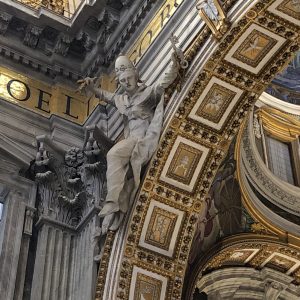
Today’s Gospel is arguably the most important passage in Scripture about Church authority, the granting of the keys to Peter. The Lord’s words to Peter give him supernatural authority: what you bind or loose on earth will be bound or loosed in heaven. The passage makes equally clear that this authority is not just for Peter personally, but that Peter is the foundation upon which Christ intends to build his Church. Jesus’ promise to protect his Church against the power of the netherworld would not be worth much if it came with an expiration date. I hope you can see what good news the Church’s authority is for all of us. When a priest grants us absolution in confession, Jesus has guaranteed the validity of that pardon in heaven. Thanks to this gift of authority, when we receive the Church’s sacraments we can be sure that it really is Christ who is working for our good.
Now, as in the time of Shebna and Eliakim, some of those who exercise authority in the Church do so better than others. This should not surprise us. Office-holders come and office-holders go. God remains the same.
One of our temptations when speaking about Church authority is to forget that it is answerable to a higher power. And if we forget the divine role in the Church’s authority, we can start to think and talk in purely political terms. Now, to be clear, I believe in American democracy as a system of civil government. But the American government is designed to do something very different than the Church’s teaching authority.
There’s a story about an old Jesuit priest, a brilliant theologian, who grew up before most of the household machines we know came into use and then lived in big Jesuit community at a university where they always hired people to do the cooking and the cleaning. One day, for whatever reason, no one was around to help, and this old father needed to wash his clothes and decided, “No problem, I’ll just figure out how the machine works and do it myself.” So he collected his laundry, went to the machine, and a few minutes later, one of the younger fathers came upon this world-renowned theologian in the kitchen carefully arranging his socks in the dishwasher.
Two different machines, two different purposes. We need to be careful thinking about Church authority in the same way we think about our political system because the two machines are designed for two different purposes. Our political system is designed to allow individuals and groups to express their wants, to compete with other individuals and groups, to compromise, and to come up with solutions that are mostly fair, though not perfect.
And what is the Church’s teaching authority meant to do? Well, what happens in the Gospel just before Jesus gives Peter the keys? Peter makes a statement of faith. He expresses the fundamental truth about who Jesus is: “You are the Christ, the Son of the living God.” Jesus asks about the public opinion polls—“Who do people say I am?” And guess what? The polls are all wrong. Because the truth is not subject to public opinion. Sometimes you’ll read about polls on Church teachings—“80% of Catholics believe this, 60% disagree with that”—and I always respond that Pontius Pilate took a poll, too, and the majority opinion was, “Crucify him.” The moderate compromise Pilate came up with was to release Barabbas. The polls were wrong.
The Church’s teaching authority is designed to teach orthodoxy. Orthodoxy simply means right belief—the truth. This is why the breathless news coverage every time a new pope is elected sometimes gets silly. Will he change this? Will he change that? Popes and bishops and even priests and laypeople can change certain things about the way we each express our faith. But even the popes have to answer to the higher authority of the truth. The pope teaches the Catholic faith because it’s true; it’s not true just because the pope says so. The pope—or a bishop or a priest or a theologian—could say “2+2=5,” but he would have no authority to do so because the Church has only been given the authority to teach the truth.
When we come to speak about the way authority works in the Church, the discussion can get very complicated, so I’m trying to emphasize what is most fundamental. What really matters is not getting what we want or what our group wants, but being faithful to the truth. Understanding the Church primarily in terms of secular politics, is like putting our cutlery and glassware into the washing machine.
Now I want to leave you with something more pleasant than the image of a washing machine full of broken dishes, so let’s close with the words of St. Paul: “Oh, the depth of the riches and wisdom and knowledge of God! How inscrutable are his judgments and how unsearchable his ways!” Orthodoxy, the truth of who God is, is better than anything we could come up with on our own. And without the Church, our image of God would be limited to just that—to our imagination. And God—the true God—is better than any of the golden calves we can imagine. He has made himself known to us in Jesus Christ through his Church because he wants us to know him as he really is, he wants us to have a relationship with him, not an imitation. Without the Church we can have an imaginary friend we call God, but we’ll never enjoy the romance of orthodoxy.
Readings: Is 22:19-23; Rom 11:33-36; Mt 16:13-20
St. Isaac Jogues Catholic Church
Rapid City, South Dakota
2017

 Tony Lusvardi, S.J.