When God puts us to the test: homily for the twentieth Sunday of Ordinary Time

Homily for the 20th Sunday in Ordinary Time (A)

Jesus is the Son of God, the savior of the world, the Prince of Peace, King of kings, and Lord of lords. He would also have been a public relations firm’s nightmare.  He is constantly saying things that are unpopular and confusing, offending all the important people, alienating even his own relatives, not taking the advice of his inner circle, and in today’s Gospel he gets caught on the record making ethnically insensitive comments.  No wonder Fr. Ed left town for this Sunday’s readings!

Today’s Gospel raises two difficult issues I’d like to touch on this morning.  The first is the way Jesus gives this woman such a hard time, as if he doesn’t want to help her.  Why?  The second issue is the role ethnicity plays in today’s readings; the woman speaking to Jesus is a Canaanite—a Gentile, not a Jew.  This issue is perhaps especially important given how much talk of racism has been in the news recently.  
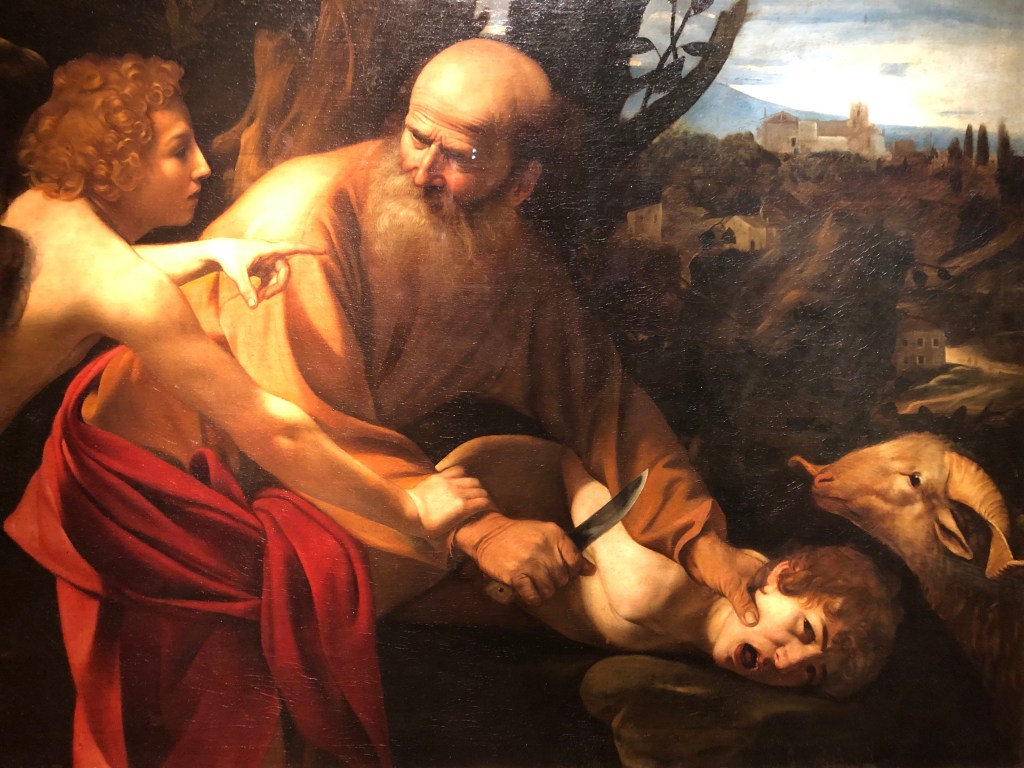
Sacrifice of Isaac, Caravaggio (1603), Uffizi Gallery, Florence

But first, why does Jesus give this woman such a hard time?  She comes to him obviously in distress because of a suffering child, the sort of situation we’ve seen Jesus handle with great compassion before, and first he gives her the silent treatment.  Then it gets worse.  Then he tells her, “We don’t serve your kind here.”  If you cringed a little bit when you heard Jesus’ words this morning, you were hearing them correctly:  “It is not right to take the food of the children and throw it to the dogs.”  Does Jesus have an evil twin?

Continue reading “When God puts us to the test: homily for the twentieth Sunday of Ordinary Time”
A Church of all nations: homily for the twenty-first Sunday of Ordinary Time

Homily for the 21st Sunday in Ordinary Time (C)

Not long ago, at dinner in my community in Rome, which houses Jesuits from maybe 30 different countries, one of my brothers from Columbia was talking with one of my brothers from Poland about the different things people eat around the world, and he mentioned hearing that in parts of Asia people eat dog meat.  And another of my brothers from the Philippines, who is normally very quiet, looked up from his plate and said, “Oh, yes, very good,” and then he went on with his meal.  

Altar of St. Francis Xavier, Gesù Church, Rome

There is no more diverse an organization in the world than the Catholic Church.  Not only do Catholics come from different countries and races and language groups, but the Church includes saints of different historical periods, the great cloud of witnesses mentioned by the letter to the Hebrews last week.  The martyrs of first century Rome, of seventeenth century Japan, of 20th century Spain and Mexico, and, in our still-young century, of Turkey, Pakistan, Kenya, Nigeria, France and elsewhere could not have been more different culturally or socially, yet they all shared a belief in Catholicism so strong they were willing to die for it.  People have indeed come, as the Lord says, from the east and from the west, from the north and from the south to the table in the kingdom of God, around which we gather this morning.

Continue reading “A Church of all nations: homily for the twenty-first Sunday of Ordinary Time”