Celebrating St. Kateri in South Dakota

July 14 is an important day for Native American Catholics: the feast day of St. Kateri Tekakwitha (1656-1680). St. Kateri’s life was characterized by courage and fidelity in the face of great suffering. She lost her parents to a smallpox epidemic as a girl, and the disease left her scarred for life and with damaged eyesight. At twenty, she converted to Catholicism and, as happens to many converts, suffered hostility for doing so. But she lived an exemplary life as a Christian, dedicating herself to caring for the sick and elderly, prayer, and devotion to the Eucharist.

In 2012, Kateri Tekakwitha, the “Lily of the Mohawks,” became the first canonized saint to hail from one of the Native tribes of North America. Her canonization by Pope Benedict XVI coincided with my time working on the Rosebud Indian Reservation in South Dakota, a deeply formative experience in my own life as a Jesuit. I knew many Lakota Catholics who had spent years praying for Kateri’s canonization, and it was a joy to be with them when the day finally came. I remember very well the beautiful Mass we celebrated in St. Charles Borromeo Church on St. Francis Mission — and the feast that followed.

St. Charles Church was recently the subject of a news segment produced by South Dakota Public Broadcasting. It is a remarkably beautiful church–recognizable on the plains for its distinctive purple color. First-time visitors stepping inside often remark on how they never expected to find such a treasure on the prairie. Its combination of Lakota art with traditional church architecture is, in my opinion, a terrific example of successful inculturation.

I was delighted when I watched the SDPB segment to see it narrated by Deacon Ben Black Bear, an expert in Lakota language and culture and a man of deep faith and spiritual insight with whom I had the honor of working on Rosebud.

If you’re looking for a way to celebrate the memorial of this great and humble saint, spend a couple of minutes watching Deacon Ben describe St. Charles Borromeo Church here:

And if you’re anywhere between Murdo, South Dakota and Valentine, Nebraska, take a detour to check out this gem of a church in person!


If you haven’t already done so, consider subscribing to this blog:
A bloody Sunday: Corpus Christi homily

Homily for the Solemnity of Corpus Christi (B)

Today’s readings are bloody.  Some years the readings for Corpus Christi emphasize the bread that becomes the body of Christ, and they remind us that the Eucharist is our nourishment and also the source of our unity.  A single loaf of bread is formed from many individual grains of wheat.  

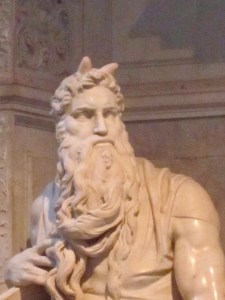
Moses, Michelangelo

But today’s readings are full of blood.  This is not a Sunday for the squeamish.  Blood sprinkled, blood shed, blood poured out, drinking blood.  If we are tempted to imagine that worship is something abstract or comfortable or safe, the blood-spattered images in today’s readings should give us second thoughts.  In the ancient world and in the time of Jesus, worship was a matter of flesh and blood, of life and death.  Entering the Temple of Jerusalem would have been a shock to the senses—crowds of visitors both from Judea and from the Jewish diaspora; animals—birds, sheep, goats, bulls—and all their animal noises and smells; the sounds of these animals being slaughtered; the smell of blood; and the songs of prayer, of the psalms rising to heaven, with the smoke of burning incense and roasting meat.  Worshipping God was not for the squeamish.

I think the fact that today’s readings speak rather vividly of the blood of goats, heifers, and bulls—bowls of blood—is perhaps a way of reminding us that Christianity—following Jesus—requires a certain courage.  In one way or another we all have to overcome our squeamishness, whatever form it might take.  The perfect act of worship, after all, the sacrifice which is the model for all other acts of worship, the death of Jesus on the cross, was not only bloody, but brutal.  There was nothing abstract or comfortable in the scrouging and beating, in the nails, the crown of thorns, or the agonizing hours on the cross.  And yet this was not, in the final analysis, merely an act of violence or a miscarriage of justice but an act of self-giving love.  The blood of the new covenant was shed for those Jesus calls to be his friends and disciples.

But why blood?  What is the meaning, for example, of what probably seems to us the very strange gesture of Moses who, to seal the covenant between God and his people, splashes blood upon the altar and then sprinkles it on the people.  When I read this passage one of my first very modern, very practical thoughts is, “How are the Israelites going to get all that blood out of their clothes?  What a mess!”  But we are told, in the letter to the Hebrews, that it is blood—the blood of Christ—that cleanses.

Continue reading “A bloody Sunday: Corpus Christi homily”

Confessing other people’s sins

Old St. Anges Church, Parmelee, South Dakota

In case you missed it, an essay of mine appeared recently in issue 19 of The Lamp, a relatively new Catholic magazine full of interesting and thoughtful writing (if I do say so myself).

“Public apologies for historical wrongs have multiplied in recent years… Yet we do not seem to have become a more reconciled and understanding society.”

This particular essay, “Confessing Other People’s Sins,” is among the most important things I’ve written. The essay draws on a lot — my experiences in South Dakota, as a confessor, and studying theology.

Benedict XVI on creation

Mount Cook, New Zealand

The new year came early for me this year–while in America 2022 still had almost a full day left to go, I was as close to the International Date Line as I’ve ever been watching fireworks erupt from the Sky Tower in Auckland, New Zealand. I will be spending the first half of the year doing Jesuit “tertianship” in Melbourne, Australia. Tertianship is the final formal stage of Jesuit formation in which we do the 30-day Spiritual Exercises again and have a chance to reflect on all that’s happened so far.

New Year’s Eve also brought the sad news of the passing of Pope Emeritus Benedict XVI, someone I have immensely admired as a man whose character balanced both courage and humility, as a Christian for whom Jesus was the center of everything, and as a theologian capable of expressing the most profound truths with luminous clarity. Benedict knew how to cut through both theological jargon and political rhetoric to get to the heart of the matter– always the absolutely unique encounter with Jesus Christ.

Rotorua, New Zealand

Shortly after Benedict’s death I was contacted by a scholar of Lakota Catholicism, Damian Costello, who wrote this article highlighting an under-appreciated aspect of Benedict’s work, his focus on creation: The unexpected way Pope Benedict helped me learn to pray with all creation. Dr. Costello’s work came to my attention last year in an insightful article in America magazine about Native American religious sensibilities and the Latin Mass. His book Black Elk: Colonialism and Lakota Catholicism makes an important and original argument, and it’s on my to-read list.

Clay Cliffs, Omarama, New Zealand
Continue reading “Benedict XVI on creation”

The Eagle

I’m back in Rome after a happy stay at St. Isaac Jogues in Rapid City, grateful for my time in America and all that I continue to learn at my adopted parish in particular.

One anecdote came back to me this morning, reading the Gospel about the call of Peter, an important passage for me in accepting my own call. Peter recognizes his own unworthiness–“Depart from me, Lord, for I am a sinful man”–but Jesus is undaunted and calls him anyway. And, of course, Peter’s subsequent story is filled with missteps, too, with the Lord again reaching out to save him and get him back on the right track. Yeah, I can identify.

At a confirmation in Rapid City a few years ago, one of my Lakota friends gave a talk that has stuck with me ever since about the eagle. Few objects are considered more sacred among Native Americans than eagle feathers, and few sights, I have to say, are more impressive than an eagle or a hawk soaring over the land.

But the point of this story was how the eagle teaches her young to fly–by carrying the little ones up into the winds and letting them go. At first they plunge, flailing and failing–until, from below, the eagle swoops down to catch them, save them, carry them aloft to try again. And that’s Jesus, my friend said, to a hushed congregation, with a conviction that could only come from knowing what it’s like to plunge and to soar.