Get Married: A review

A couple of years ago I taught a seminar on the sacrament of marriage, using Mark Regnerus’s excellent book The Future of Christian Marriage, which I reviewed for the Homiletic and Pastoral Review. I taught the same seminar again this past semester and reviewed another recent contribution to the subject, Brad Wilcox’s  Get Married: Why Americans Must Defy the Elites, Forge Strong Families, and Save Civilization (Broadside Books, 2024). You can read the review below or visit HRP and read it again!

Marriage is among the most important social justice issues of our day.  Classic Catholic social teaching—think Leo XIII in Rerum Novarum—has long recognized the connection between social well-being and a family life built on marriage. As Brad Wilcox points out in Get Married: Why Americans Must Defy the Elites, Forge Strong Families, and Save Civilization, “questions of marriage and family” are better predictors of positive or negative social outcomes than “race, education, and government spending” (xiv).  Yet even in Catholic circles, questions of marriage and sexual ethics are often treated not as issues of pressing social concern, but as matters of private morality—or dismissed as “cultural issues.”

Such dismissiveness has little theological basis.  And Wilcox—a professor of sociology and the director of the National Marriage Project at the University of Virginia—demonstrates that it is even harder to justify from a sociological point of view.  Marriage is good both for society as a whole—a higher percentage of married parents correlates with lower child poverty (73)—and for individuals, both men and women, who report higher rates of happiness, find more meaning in their lives, and are less lonely than their unmarried—and childless—peers (51-52, 115, 121).

Continue reading “Get Married: A review”
The Vatican Nativity Scene, 2025

Vatican Nativity Scene 2025, St. Peter’s Square

While the tradition of a Nativity display dates back to St. Francis of Assisi, today such scenes are most associated with the city of Naples. There such displays came to include not just the figures of Mary, Joseph, and baby Jesus in a manager, but whole surrounding countrysides and cityscapes crowded with figures and replete with detail. These Neapolitan scenes reached their heyday in the 17th and 18th century and today provide a view into what life was like at that time. They feature all strata of society from nobles and servants to shopkeepers and children.

Continue reading “The Vatican Nativity Scene, 2025”

Humility is our glory: homily for the 22nd Sunday in Ordinary Time

Homily for the twenty-second Sunday in Ordinary Time (C).

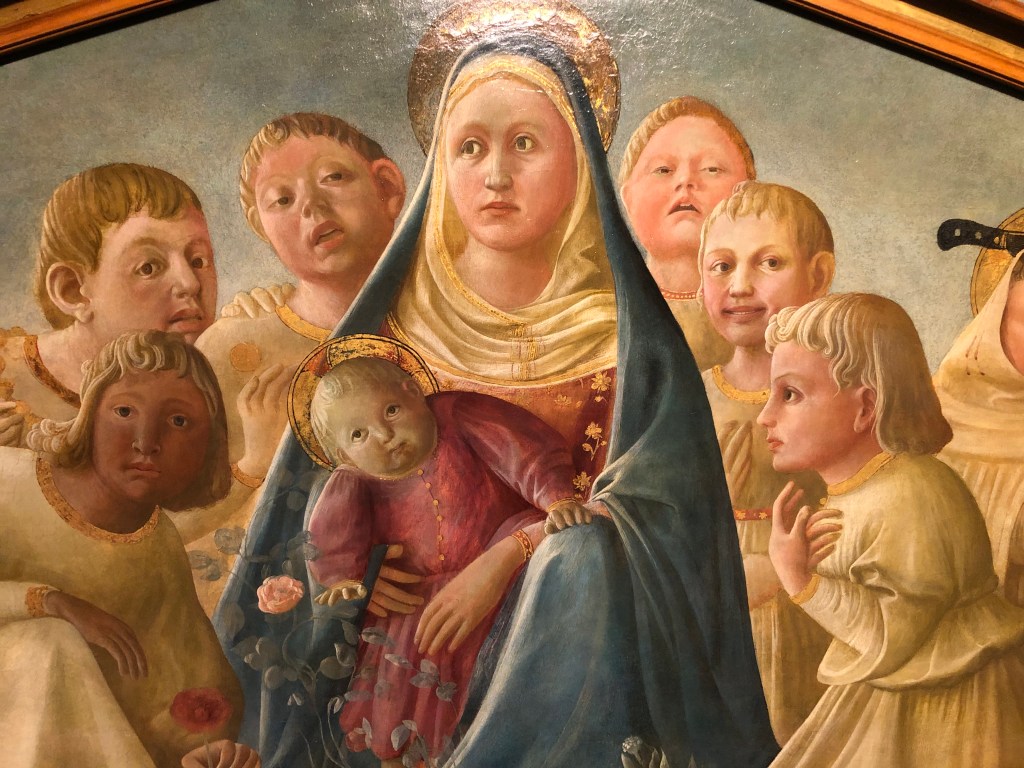
Filippo Lippi, Madonna of Humility, 1420

Humility is the virtue that stands out both in today’s Gospel reading and in Sirach’s advice to “conduct your affairs with humility” and to “humble yourself the more, the greater you are.”  I’ve been thinking about humility a lot this summer because I’ve been thinking about my grandfathers.  One passed away in June, the other fourteen years ago, and “humble” is one of the first words that comes to mind when I think of either of them—perhaps in both cases because my grandfathers were the quiet ones, and my grandmothers were the talkers!  One grandfather was a baker, the other lived his whole life in the same small town in Minnesota.  I think of them both as great men not because they sought attention or prestige, but because they didn’t.  Because they dedicated themselves to others, to their families and to their communities, without making a fuss about it, and left the lives of many better as a result.  In the homely etiquette lesson Jesus offers in the Gospel—take the lower place instead of elbowing your way to the head of the table—he points to one way in which a humble act can leave one better off in the long run.

Continue reading “Humility is our glory: homily for the 22nd Sunday in Ordinary Time”

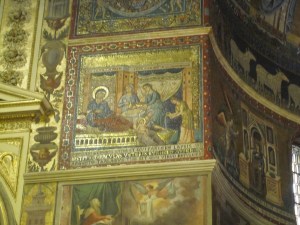
Saints Joachim and Anne, grandparents of Jesus

Santa Maria in Trastevere

It’s been one of the great blessings of my life to have gotten to know all four of my grandparents and to have them with me well into adulthood. Particularly in times that change so quickly and so dramatically, grandparents give us access not just to another generation but, really, to other worlds.

On this memorial of St. Joachim and St. Anne, I came across this quotation from one of the 20th century’s literary giants:

I feel that all my writing has been about the experiences of the time I spent with my grandparents.

Gabriel García Márquez