

Hurrah for monogamy!

Cupid aims his arrow! From “Venus, Mars, and Cupid,” Guercino, 1633

Late last year, the Vatican’s Dicastery for the Doctrine of the Faith issued Una Caro a document praising monogamy. Monogamy is indeed a praiseworthy institution and not one to be taken for granted these days when everything seems up for grabs. In my seminar on marriage last semester, a student brought to my attention the story of a Protestant pastor in Berlin blessing a “marriage” of four men. And I know from the discussions about marriage in my introduction to the sacraments class at the Gregorian University that polygamy remains a real pastoral challenge in many parts of the globe.

I was happy to be able to review Una caro in the latest issue of La Civiltà Cattolica, adding some insights from recent sociological studies on marriage by Brad Wilcox, Mark Regnerus, and the Belgian sexologist Thérèse Hargot. These sort of studies cannot substitute for a theology of marriage, but they do provide an invaluable supplement to it, if for no other reason than that they help to dispel some of the myths used to deride the Christian vision of marriage.

Continue reading “Hurrah for monogamy!”
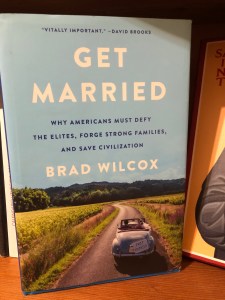
Get Married: A review

A couple of years ago I taught a seminar on the sacrament of marriage, using Mark Regnerus’s excellent book The Future of Christian Marriage, which I reviewed for the Homiletic and Pastoral Review. I taught the same seminar again this past semester and reviewed another recent contribution to the subject, Brad Wilcox’s  Get Married: Why Americans Must Defy the Elites, Forge Strong Families, and Save Civilization (Broadside Books, 2024). You can read the review below or visit HRP and read it again!

Marriage is among the most important social justice issues of our day.  Classic Catholic social teaching—think Leo XIII in Rerum Novarum—has long recognized the connection between social well-being and a family life built on marriage. As Brad Wilcox points out in Get Married: Why Americans Must Defy the Elites, Forge Strong Families, and Save Civilization, “questions of marriage and family” are better predictors of positive or negative social outcomes than “race, education, and government spending” (xiv).  Yet even in Catholic circles, questions of marriage and sexual ethics are often treated not as issues of pressing social concern, but as matters of private morality—or dismissed as “cultural issues.”

Such dismissiveness has little theological basis.  And Wilcox—a professor of sociology and the director of the National Marriage Project at the University of Virginia—demonstrates that it is even harder to justify from a sociological point of view.  Marriage is good both for society as a whole—a higher percentage of married parents correlates with lower child poverty (73)—and for individuals, both men and women, who report higher rates of happiness, find more meaning in their lives, and are less lonely than their unmarried—and childless—peers (51-52, 115, 121).

Continue reading “Get Married: A review”