Susanna and the wicked judges

Monday of the fifth week of Lent brings one of the Bible’s great courtroom dramas — the story of Susanna and the elders from the Book of Daniel. It’s one of the longest readings in the lectionary, but one that deserves to be read with relish. An innocent woman does what is right even at the cost of her life. Two powerful and corrupt men, overthrown by lust, suppress their consciences, and compound debauchery with vindictiveness. And a lone idealistic voice, indignant at the injustice of the crowd, speaks out — and the old goats are snared in the net they’ve woven.

Susanna and the Elders, Guercino, 1617

There’s something refreshing about the story. It’s not hard to tell the bad guys from the good gal, and for once justice is throughly vindicated. A few weeks ago in my post about Guercino, I mentioned the baroque era’s love of drama (one might be excused for saying “melodrama”). I was happy to see Guercino take up the story of Susanna. Quite a lot could be said about tale — the Lord hears the cry of the innocent even when everyone else seems deaf — but it is, first of all, a great yarn. As we look forward to Holy Week, Susanna’s travail is a reminder that, even if it doesn’t always happen quickly — or even in this life — justice will ultimately prevail.

Susanna and the Elders, Guercino, 1617

The Certosa di San Martino and the Neapolitan baroque

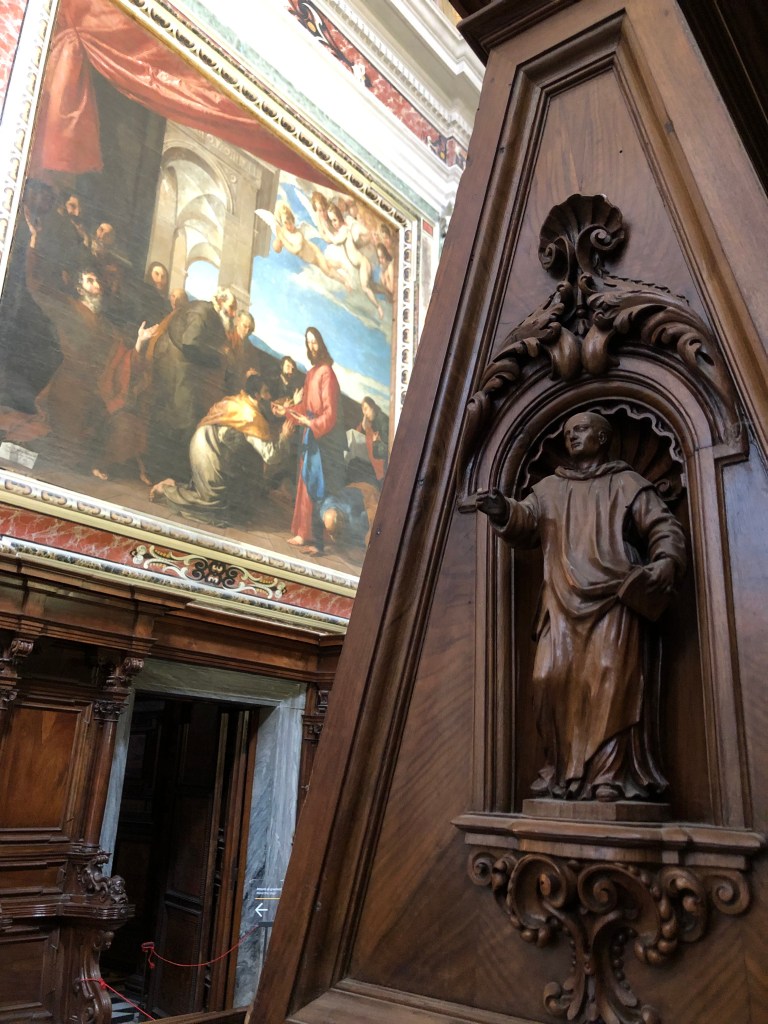
Inside the choir of the Certosa di San Martino (Naples)

A couple of weeks ago, I wrote about the connection between the baroque style, the Jesuits, and the city of Rome. It’s hard to find a city that can outdo Rome in baroqueness, though Naples gives the Eternal City a run for its money. I took a day trip down to Naples in mid-March to meet up with my parents who were vacationing there and was reminded what a treasure trove of marvels that city is.

We got in to visit one of the sights I’ve been wanting to see for a long time, Giuseppe Sanmartino’s Veiled Christ (1753). I had seen pictures before of this virtuoso use of marble–carved as if a thin, almost translucent, shroud had been draped over the figure of the dead Christ. What makes the sculpture so moving, however–something I hadn’t appreciated until seeing it in person–is the liquid quality the shroud creates. The way it clings to the flesh below, with the wounds visible through it, and pools around the edge of the body almost makes you feel the life draining from the corpse. The rest of the chapel is chockfull of allegorical figures, though photography is prohibited inside, so you’ll just have to go to Naples to see for yourself!

Chapel, Certosa di San Martino (Naples)

One of the visit’s surprises was to discover the Certosa di San Martino, a Carthusian Monastery, now a museum, tucked under imposing walls of the Castle of Sant’Elmo overlooking the city. We went up for the view from the Vomero hill and just happened into the Certosa, founded in 1368 but redone in extravagant baroque in 1623.

Continue reading “The Certosa di San Martino and the Neapolitan baroque”

Guercino, Rome, and the Jesuit baroque

Guercino, Moses

One is always discovering new artists in Rome, and earlier this year, thanks to a special exhibit at the Scuderie del Quirinale and the recommendation of a friend, I discovered Guercino (1591-1666). Born Giovanni Francesco Barbieri in Cento (Emilia-Romagna), he worked in Rome when baroque art was at its zenith.

Guercino, Gregory XV, ca. 1621

The exhibit was of particular interest to me because Guercino’s time in Rome corresponded to the period when the Jesuits were also at their zenith. The pope who proved to be Guercino’s great patron, Gregory XV (Alessandro Ludovisi), also favored the Society of Jesus, especially in its mission of spreading Catholicism around the globe.

The Jesuits have often been associated with the baroque because it was the artistic style in vogue around the time of our founding, so our great Roman churches, the Gesù and Sant’Ignazio — and all the other Jesuit churches around the world built to imitate them — are classic examples of baroque architecture.

Guercino, St. Peter Raising Tabitha, 1618
Continue reading “Guercino, Rome, and the Jesuit baroque”