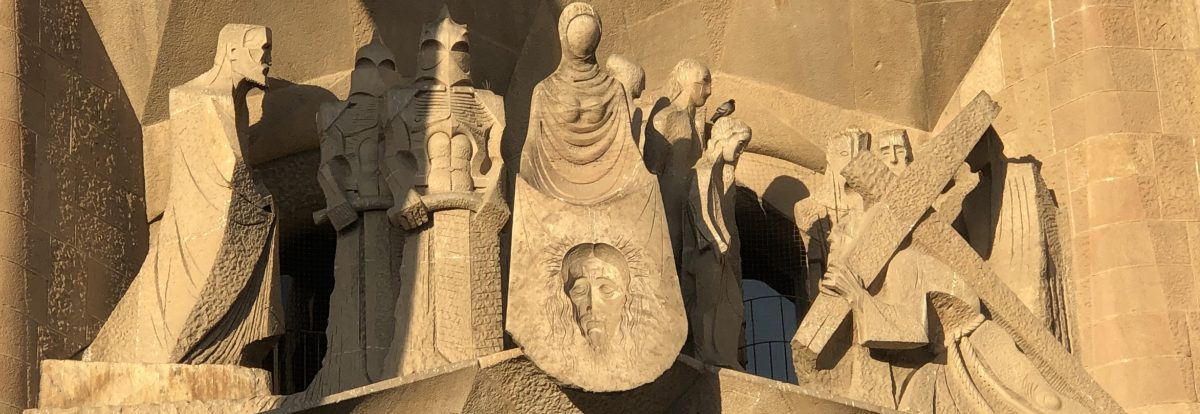
Choose life, South Dakota: homily for the twentieth Sunday in Ordinary Time

Homily for the 20th Sunday in Ordinary Time (B)

If there is one theme consistently present throughout the whole Bible, from the first chapter of Genesis to today’s Gospel, it is that God desires to give us life.  When he reveals the commandments to Moses on Mount Sinai, he tells the people of Israel, “I have set before you life and death, the blessing and the curse.  Choose life, then, that you and your descendants may live” (Dt 30:19).  Today the Eucharist too is presented as life-giving: “The bread that I will give is my flesh for the life of the world” (Jn 6:51). 

It is fitting that today’s readings would highlight God’s desire to give us life, because, as I mentioned last week, the bishops of South Dakota have asked us to speak these two Sundays about a particularly urgent social issue: a measure, Amendment G, has been placed on the ballot this November, which would add the right to abortion without significant limits to the South Dakota constitution.  As I pointed out last week, Christianity is not a political program, and Catholics can disagree about most political issues while still remaining faithful to the principles of our faith.  Amendment G, however, is impossible to reconcile with the fundamental principle that it is always wrong to deliberately kill an innocent human being.

This principle is something that both conservatives and liberals should be able to embrace.  Conservatives emphasize the government’s duty to protect and not usurp individual rights, and without the right to life no other rights are possible.  Even a libertarian “live and let live” philosophy only works if you let the other live.  Take away the right to life and you have neither conservative government nor a free people, but the oppression of the weak.  

Continue reading “Choose life, South Dakota: homily for the twentieth Sunday in Ordinary Time”

Abortion, public policy, and the Catholic bishops

This article by Richard Doerflinger in America magazine “The U.S. bishops aren’t the extremists in the abortion debate” makes what I think are some very important points about the Catholic Church’s teaching on abortion and public policy. It answers a few questions I’m sometimes asked and clears up some misunderstandings.

Catholic teaching does, in fact, allow for an incremental approach to ending abortion, as Pope St. John Paul II taught in Evangelium Vitae, 73. This means that, while Catholic politicians can never legitimately vote for more permissive abortion laws, they can in good conscience make reasonable compromises when advancing pro-life legislation.

Continue reading “Abortion, public policy, and the Catholic bishops”

Abraham’s promises: homily for the sixteenth Sunday in Ordinary Time

Homily for the sixteenth Sunday in Ordinary Time (C)

This morning, I want to talk about Abraham.  For many of us, perhaps, Abraham is like one of those distant relatives your grandmother mentions occasionally but you’re never quite sure how you’re related.  Fortunately, it’s easy to see how Abraham fits into the family tree.  He’s at the top—Abraham is the patriarch, the father of the Jewish people and also, according to the New Testament, the father of us all in faith.

Caravaggio, Sacrifice of Isaac, Uffizi Gallery, Florence

We find Abraham’s story in the book of Genesis.  He lives in that period in history after the fall, when the sin of Adam has left humanity existentially disoriented.  It’s the era of Cain and Abel, the Tower of Babel, Noah and the Flood—man is lost, and every turn he makes only worsens his desolation.  When I was in the Peace Corps, I was once heating a bucket of water with an electric coil, which was, shall we say, not up to OSHA standards.  And without noticing that the plastic safety handle around the coil had melted, I picked it up and gave myself a shock.  And in the moments after the shock, everything was fuzzy, and I couldn’t quite tell what had happened or what I was doing—so I picked it up and shocked myself again.  And that’s kind of what original sin did to mankind.

Continue reading “Abraham’s promises: homily for the sixteenth Sunday in Ordinary Time”

A challenging examination of motherhood

Over at America, my friend Rachel Lu has authored the most thought-provoking reaction I’ve seen so far on what appears to be the downfall of Roe vs. Wade, Do we really honor motherhood?. It’s both personal and penetratingly analytical, a thought-provoking lead-up to Mother’s Day.

Roe vs. Wade was a horrific decision in every respect, an act of judicial lawlessness, the fruits of which can be seen in the lawless tactics — from slandering Supreme Court nominees to this week’s leak and violent protests — employed to defend it. Violence begets violence. There seems no line of decency or ethics that Roe’s partisans will not cross to protect it — like a lie that requires a whole string of other lies to keep it going. Listening to the President bluster about having the “right” to abortion-without-limits “because I’m just a child of God, I exist,” one cannot help but wonder, Have you no shame, man?

Rachel’s essay goes deeper than political debates and gets at more complex questions of our social and human identity. There’s plenty in it to challenge everyone’s thinking, including theologians and pro-lifers. It suggests ways in which we’ve ended up with the brutal culture of abortion that has prevailed in Roe’s wake by taking the sacrifices women make to be mothers for granted. I’ll offer just one example, Rachel’s surprising analogy between soldiers and mothers.

At first glance, it might seem strange to compare mothering to soldiering; one involves killing and the other fosters life. In many ways though, the parallels are quite strong. Historically, these are the only two demanding vocations that have been foisted on people in nearly all human societies, with little or no regard for their personal feelings or level of preparation. The demands are daunting, but failure can bring crippling consequences for individuals and society. Motherhood is also like military service in that both require recruits to put their very bodies on the line, running very real risks of disfigurement or death. These remarkable demands are justified in the simplest of terms: They are necessary. Civilization itself is at stake.

Rachel Lu

The rest is worth more than a casual read. Read the full article.