
A couple of years ago I taught a seminar on the sacrament of marriage, using Mark Regnerus’s excellent book The Future of Christian Marriage, which I reviewed for the Homiletic and Pastoral Review. I taught the same seminar again this past semester and reviewed another recent contribution to the subject, Brad Wilcox’s Get Married: Why Americans Must Defy the Elites, Forge Strong Families, and Save Civilization (Broadside Books, 2024). You can read the review below or visit HRP and read it again!
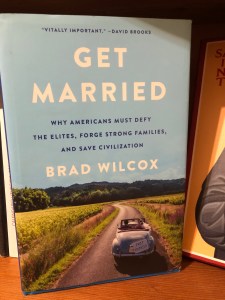
Marriage is among the most important social justice issues of our day. Classic Catholic social teaching—think Leo XIII in Rerum Novarum—has long recognized the connection between social well-being and a family life built on marriage. As Brad Wilcox points out in Get Married: Why Americans Must Defy the Elites, Forge Strong Families, and Save Civilization, “questions of marriage and family” are better predictors of positive or negative social outcomes than “race, education, and government spending” (xiv). Yet even in Catholic circles, questions of marriage and sexual ethics are often treated not as issues of pressing social concern, but as matters of private morality—or dismissed as “cultural issues.”
Such dismissiveness has little theological basis. And Wilcox—a professor of sociology and the director of the National Marriage Project at the University of Virginia—demonstrates that it is even harder to justify from a sociological point of view. Marriage is good both for society as a whole—a higher percentage of married parents correlates with lower child poverty (73)—and for individuals, both men and women, who report higher rates of happiness, find more meaning in their lives, and are less lonely than their unmarried—and childless—peers (51-52, 115, 121).
While Wilcox’s book is meticulously argued and his claims supported with abundant data and nuanced analysis, Get Married does not assume a neutral stance. The book’s title is an imperative. While Wilcox acknowledges that marriage is not for everyone, he aims to deconstruct many of the popular myths that undercut marriage in contemporary American culture, taking aim at the misogynistic influencer Andrew Tate (ix) as well as feminist columnists who describe children and commitments as burdens (113). Being a part of a larger, future-oriented project that involves commitment and sacrifice, it turns out, is more satisfying in the end than a perpetual adolescence.
One of the ironies the book identifies is the “reverse hypocrisy” of today’s secular elites (218). When it comes to their own lives, upper-crust and educated Americans live traditional family lives—married mother-father households—while promoting a progressive ideology of “family diversity.” The elites can ignore the social consequences of this ideology because they don’t follow its tenets themselves.
Wilcox dedicates a number of chapters to explaining the decline in marriage among the general population—especially the working class—over the past several decades, locating the roots of the problem in the highly individualistic, pro-divorce ethos of the 1970s. He dissects claims bandied about in the popular media that tend to undermine the value of marriage and family—the “soulmate” myth; that “love” and money are better indicators of success than family structure; that children mean the end of happiness; that spouses ought to put their own needs before family; that gender makes no difference when it comes to marital roles.
The tone of the book, however, is not set by the cultural failures of recent decades. Wilcox analyzes certain subgroups in American culture that have maintained strong marital cultures: Asian Americans, conservatives, religious believers, and what he calls “strivers”—the educated classes who walk the walk of a traditional lifestyle even if they talk the usual rainbow-colored pieties. A significant number of strivers are the children of divorce reacting against the “easy come, easy go marital ethics of so many of their parents” (xxi).
Throughout the book, Wilcox provides insights into those habits and attitudes that tend to contribute to stable marriages, making it valuable for those involved in pastoral ministry with married couples. At a time when the Church’s understanding of marriage can no longer be taken for granted—and is often loudly opposed—Catholic leaders must be more proactive in articulating and advocating our teaching. Wilcox’s book is a valuable resource to help us do so. With cultural headwinds against us, we are sometimes at risk of unconsciously adopting a narrative in which Christianity’s marital ethic is seen as unrealistic and curmudgeonly. Wilcox exposes the deception of this trap: the evidence shows that no group of Americans is happier than husbands and wives who share a common faith (227). And no institution is more essential for the well-being of children, as a bulwark against poverty, or for the future of society.
If you want justice, work for marriage.

 Tony Lusvardi, S.J.
One thought on “Get Married: A review”