Homily for the Baptism of the Lord (C)
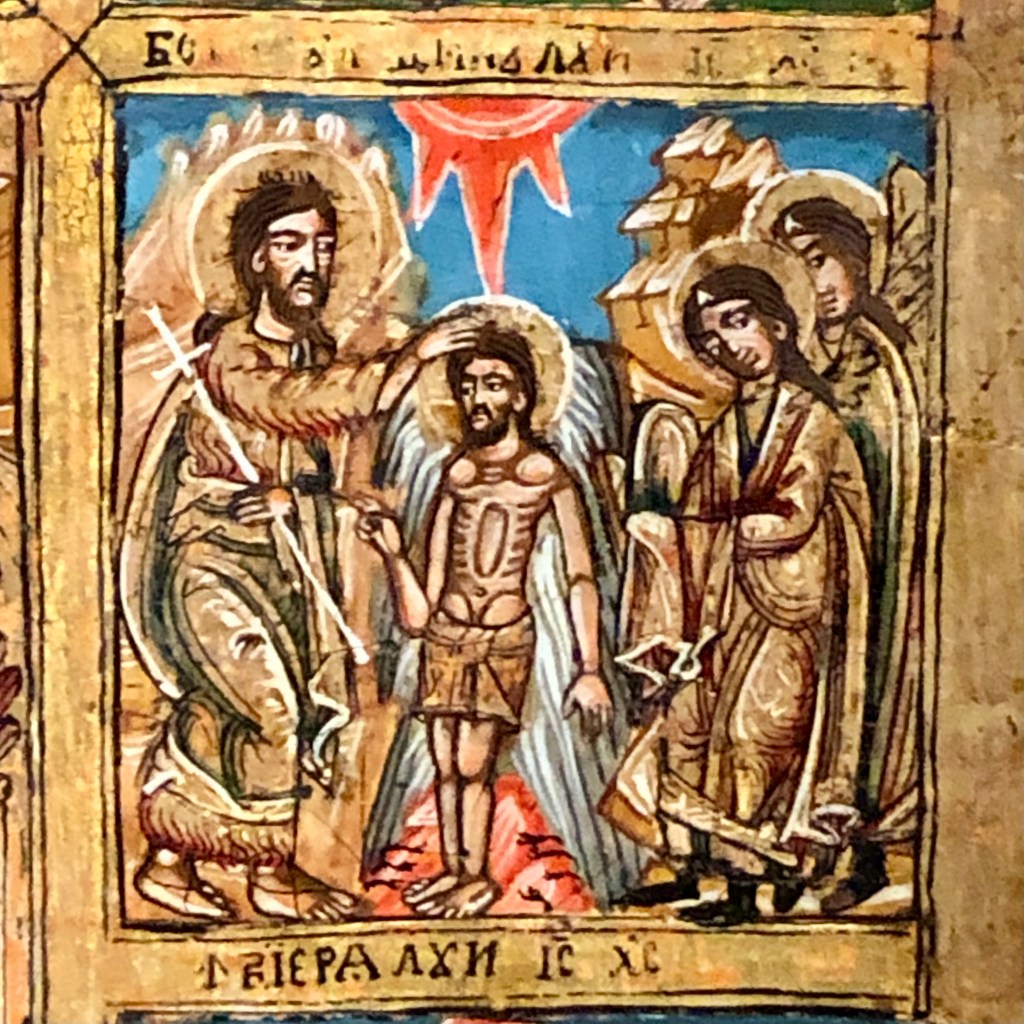
Today’s readings use some artful cinematography. Today we celebrate the Baptism of the Lord. Our readings give us scenes before baptism and immediately after baptism, but they cut away so that we don’t see the baptisms. This montage of before and after shots nonetheless serves to highlight the uniqueness of Christian baptism. Luke cuts from John the Baptist’s preaching to Jesus praying after his baptism. The Holy Spirit descends like a dove and a voice from heaven speaks to the Lord. The scene is obviously meant to show approval for Jesus’ baptism at the hands of John.
The scene chosen today from Acts of the Apostles is also meant to put the stamp of divine approval on baptism. To understand Peter’s words in the house of Cornelius, we need to remember the whole context of the chapter in which they occur, Acts 10. The scene unfolds in the earliest days of the Church when there was still doubt about who could belong to the Church: was the message of Jesus directed only to Jews or were all people called to Christianity? In Acts 10, the centurion Cornelius—a Roman, not a Jew—receives a vision that prompts him to call Peter to his house. At the same time, Peter receives a vision in which he’s told to eat all of the animals that Jewish dietary laws consider forbidden. The vision was not a marketing ploy for the pork and shellfish industry, but instead it ensured that Peter didn’t hesitate to go to a Gentile’s house when Cornelius’s servants came to find him. At Cornelius’s house Peter preached the message that we hear today. The word was sent to the Israelites, he says, but it was intended, as Isaiah prophesied in the first reading, “to bring forth justice to the nations,” in other words, to extend beyond Israel itself.
What we unfortunately don’t read today is what happens next. As if anyone missed the first several hints, the Holy Spirit descends on the people in Cornelius’s house, who begin to speak in tongues, and Peter says, “Can anyone forbid water for baptizing these people?” (Acts 10:47). God’s will is that baptism should be conferred on Gentiles as well as Jews and that all nations should enter the Church, even Roman centurions.
Now if you were a medieval theologian, who spent your days raising difficulties about sacramental theology, the story of Cornelius’s baptism might provoke another question: if the Holy Spirit had already descended on everyone in Cornelius’s household, why did they even need to be baptized? Isn’t getting the Holy Spirit the whole point of baptism? And once you’ve got the Holy Spirit, doesn’t the ceremony become redundant? If you remember from Matthew’s account of the baptism of Jesus, John the Baptist himself poses a similar question about the baptism of Jesus. “I need to be baptized by you,” he says. “Why do you come to me?” (Matt 3:4).
But there too, Jesus insists. The problem with questioning Cornelius’s need to be baptized is that the Holy Spirit himself does not seem to think that baptism is redundant. He goes to an awful lot of trouble—multiple visions, a miraculous descent, the gift of tongues—in order to make sure that Cornelius and his family get baptized. So any theology that reduces baptism as a mere ceremony, an ex post facto formality, seems to contradict the Holy Spirit’s own designs.
The sacraments—baptism, certainly, but the Eucharist and all the others—are not mere formalities. Nor are they mere delivery vehicles, like Uber for the Holy Spirit. They aren’t envelopes in which we receive little packets of grace or tickets for Church membership. They are encounters with the Lord, in which Jesus himself is present and acts.
Let’s go back to the baptism of Jesus. After he is baptized, the Father says, “You are my beloved Son; with you I am well pleased.” Jesus knows this; he has always been God’s Son. John is right that Jesus is not baptized for his own good. He is baptized for our good. It’s not an accident that the feast of the baptism of Jesus comes at the end of the Christmas season because the mystery that we celebrate on Christmas and today is the Incarnation. The Son of God descends into our world—into the womb of Mary—in order to meet us in the flesh. And the Son of God descends into the waters of baptism—the womb from which we are born again—in order to meet us in the sacraments.
The sacraments are necessary not because we get something from them—as if sacramental grace were a gift like gold or frankincense or myrrh that we could put in a jar and carry around—but because they put us into an utterly unique relationship with Jesus. They are encounters with Jesus in the flesh. The Father does not speak from heaven in order to inform Jesus who he is but in order to reveal to us who we become in this sacrament. For in baptism, we are born into a new relationship. United with Jesus, we become his brothers and sisters and, in virtue of our communion with him, the sons and daughters of God.
The cinematography of today’s readings is meant to ensure that we don’t miss how unique this sacramental event is. John emphasizes the difference between his baptism and the baptism that Jesus will give, baptism “with the Holy Spirit and fire.” In another passage in Matthew, Jesus says about John, “Among those born of women there has arisen no one greater than John the Baptist; yet he who is least in the kingdom of heaven is greater than he” (Matt 11:11). More could be said, but the fundamental point is that the gift of Christian baptism, the relationship it creates with Jesus, is utterly unique and admits no substitutes. It means union with Jesus in his flesh and in his death and resurrection.
Baptism, of course, finds its fulfillment in the Eucharist, which we are about to celebrate. There too we encounter Jesus in the flesh. So as this Christmas season comes to a close, we might to be especially grateful for that gift of Jesus’ presence, that gift promised to all nations by Isaiah and by John; made possible by the “yes” of Mary; revealed to wise men and later to Cornelius; the gift of the Word made flesh who dwelt among us so that we could become the sons and daughters of God.
Readings: Is 42:1-4, 6-7; Acts 10:34-38; Luke 3:15-16, 21-22
Oratorio San Francesco Saverio del Caravita, Rome
January 12, 2025

 Tony Lusvardi, S.J.